This paper originally appeared in The Meadowlark: The Journal of the Illinois Ornithological Society
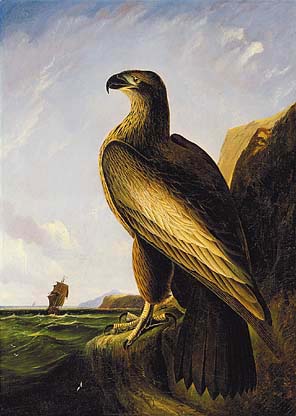
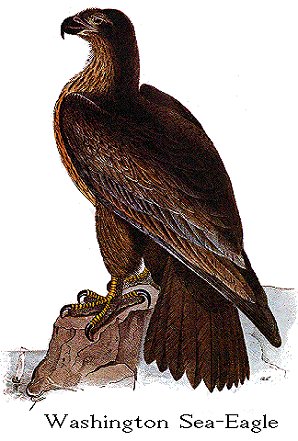
For over one hundred years, ornithologists have been in general consensus that John J. Audubon's enormous (10+ wingspan) "Bird of Washington" (Washington eagle) was a classic case of misidentification. New research now shows that it may have truly existed until modern times.
Firstly, my apologies to those who do not like long blog entries. This is
not short. The following entry was a paper I composed that was originally published in two ornithological jounrals,
Meadowlark: The Journal of Illinois Birds and
The Ohio Cardinal: The Journal of the Ohio Ornithological Society. Only, if you are not a member of either of these ornithological societies, one could not be exposed to the findings. Therefore, I have chosen to finally publish the paper here, as a means of opening it to the public at large for comment and review:
Substantiating Audubon’s Washington Eagle
It is widely known that American statesman Benjamin Franklin lobbied for the wild turkey to serve as America’s national bird, but few know which species the great naturalist John James Audubon would have promoted had he had a voice in the matter. His preference can be gleaned from the following excerpt from his early writings, in his Ornithological Biography (1840):
…it is indisputably the noblest bird of its genus that has yet been discovered in the United States, I trust I shall be allowed to honour it with the name of one yet nobler, who was the saviour of his country, and whose name will ever be dear, to it. To those who may be curious to know my reasons, I can only say, that, as the new world gave me birth and liberty, the great man who ensured its independence is next to my heart. He had a nobility of mind, and a generosity of soul, such as are seldom possessed. He was brave, so is the Eagle; like it, too, he was the terror of his foes; and his fame, extending from pole to pole, resembles the majestic soarings of the mightiest of the feathered tribe. If America has reason to be proud of her Washington, so has she to be proud of her great eagle. (Audubon 1999:220)*
Audubon had admired, studied, and painted both bald and golden eagles, but this “great eagle” he lauded as “mightiest of the feathered tribe” was neither of these. North America was once home to no less than seven species of eagles, but the demise of the great mega-fauna that once dominated the New World landscape and the emergence of humans onto the continent had whittled the number of native species to two long before Columbus arrived (Brodkorb 1964, Howard 1930 & 1932). That is, unless one considers certain writings of the early nineteenth century; it is here archivists find Audubon’s (and others’) detailed descriptions of a possible third American eagle species surviving into the modern era: the “great eagle”—the Bird of Washington.
Over many decades, this bird was given several consubstantial names: Washington’s eagle, Washington’s sea-eagle, Washington eagle, and the great sea-eagle. Audubon’s most frequently used appellation was the “Bird of Washington.” For simplicity’s sake, the bird will herein be referred to as the Washington eagle.
This impressive bird was a favorite of Audubon’s, eliciting euphoric expressions of the sentiments inspired by sightings of the species:
It was in the month of February 1814, that I obtained the first sight of this noble bird, and never shall I forget the delight which it gave me. Not even HERSCHEL, when he discovered the planet which bears his name, could have experienced more rapturous feelings (Audubon 1999:217).
Later, upon finally acquiring a specimen, he described himself as filled “with a pride which they alone can feel, who, like me, have devoted themselves from their earliest childhood to such pursuits, and who have derived from them their first pleasures” (Audubon 1999:220).
* All references herein to the writings of Audubon are to C. Irmscher’s superb Library of America edition (1999).
Even as Audubon first published and described the Washington eagle as the ninth and largest of the world’s species of sea-eagles, he recognized the bird as already exceedingly rare and possibly near extinction (Aud.1829:116). Audubon referred to it in correspondence as the “great rara avis” (Rhoads 1903:382). It was popularly accepted as a unique species throughout Audubon’s lifetime, and included as a good species in texts by the most reputable ornithologists (Cassin 1853). It was not long after its inclusion in his Ornithological Biography in 1831, however, that the Washington eagle was labeled as suspect among some naturalists. In 1838, Jared P. Kirtland, in the course of cataloguing Ohio’s birds, hinted at this doubt by using the phrase “if it be a true species” when referring to the Washington eagle. Misgivings he may have harbored did not prevent him from later recording a sighting of a Washington eagle on a Cleveland beach in 1842 (Christy 1936).
Though the great eagle’s rarity and the fact that such an enormous bird had so long escaped description were primary causes for consternation among early critics, the mere fact that it was Audubon who had first encountered it was enough for the most vocal of them. Audubon was never at a loss for detractors of his written and artistic works. Their attacks were most notoriously orchestrated by George Ord and Charles Waterton, and played out in personal correspondence (including a ten-page letter/thesis Ord sent to Waterton, arguing that the Washington eagle could not have been as large as Audubon described) as well as in scathing papers, many of them published in Loudon’s Magazine of Natural History during its early years of publication 1831-1835 (Souder 2004:323, Klauber 1971:493). Audubon seldom replied publicly to such abuse, commenting that “[t]o have enemies is no uncommon thing.” Eventually, these canorous critiques cost Audubon certain impressions of credibility that ultimately hindered the acceptance of his Washington eagle, along with those for other natural phenomena he had witnessed and described.
When Audubon illustrated mockingbirds for his Birds of America, he depicted them defending a nest against a rattlesnake. His enemies and deprecators assailed him on this, arguing that rattlesnakes cannot climb trees (Herrick 1917). Observations in times to come, however, have justified Audubon’s artistic license and showed that rattlesnakes can and do indeed climb trees, though rarely (Klauber 1971:493-494). Likewise, until his death Audubon was accused by botanists of having fabricated the presence of the “yellow water-lily,” which he included in his Birds of American under the name of Nymphaea lutea. Only decades later in 1876 was his defiant refusal to retract his depiction justified by the “rediscovery” of the long-lost plant in the Florida Everglades (Lockwood 1877, Davis 1997).
Following Audubon’s death in 1851, incredulity about the Washington eagle accelerated to the point that a generation later it was said only “amateur ornithologists” still considered it a valid species (Allen 1870:525). When asked to comment on the Washington eagle, the eminent Elliot Coues was quoted as saying, “I wonder how many times the ‘Washington eagle’ must be put down before it will stay down! As a species, it is a myth...” (Gilpin 430).
Today, it is universally believed that the few Washington eagles Audubon and others saw and expounded upon were not members of a previously unidentified eagle species, but were rather a common bird known long to naturalists: the northern subspecies of the bald eagle Haliaeetus leucocephalus alascanus in its immature state of development. In early days, the immature bald eagle was sometimes referred to as a separate species: the brown or sea eagle, Falco ossifragus, but the best early naturalists, Wilson and Audubon among them, soon recognized the true relationship. Critics explain that Audubon was unacquainted with the distributional, developmental, and sexual-dimorphic variations in the bald eagle’s size and the multiple plumages involved during its development to maturity (Durant et al. 1980:61, Allen 1870:525). While it is true that the immature stages of the bald eagle are generally brown, it would be hasty to unquestioningly conjoin the two birds without a thorough discrimination of their traits, and an examination of Audubon’s detailed physical description of a specimen. It would also be unjust to such a noble bird, if it were to have existed, to brush it aside with so little ado.
To make a case for the existence of the Washington eagle and prove that the Washington eagles were not immature bald eagles, it is necessary to rebut historical and contemporary skeptics by demonstrating that the bird’s distribution, morphology, and ethology lay outside the accepted range of variation for the bald eagle, especially those of its juvenal stages.
If indeed the Washington eagles were simply immature northern bald eagles, they should have been seen and noted quite frequently in Audubon’s winter travels along the Mississippi, Ohio, and Missouri rivers. Indeed, his river journals are replete with sightings of “brown eagles,” but Audubon was aware of Alexander Wilson’s theory that these “brown” and bald eagles were of the same species (Audubon 1999:17), and even noted for the uninformed reader that the term “brown eagle” is used “meaning the White-headed eagle (Falco leucocephalus) in its immature state” (Audubon 1999:218). The sole time within his 1820-21 journal that he references the then-unnamed Washington eagle, the addendum “i.e. S. Eagles” [sea eagles] was added to the label of “brown eagles” to clarify the difference. Here he noted that the “S. Eagles” he had seen previously—the Washington eagles—were “at least ¼ longer” than the bald and brown eagles he was encountering on the lower Ohio River (Audubon 1999:19).
Audubon recorded numerous encounters with the abundant bald/brown eagles in his lifetime, but only five sightings of the Washington eagle. In chronological order, these occurred on the Mississippi and Ohio rivers near the cities of Grand Tower, Illinois; Evansville, Indiana; Henderson, Kentucky; Clarksville, Indiana; and Mound City, Illinois. The five sightings involved ten birds (never more than two adults in any one area), yielded a close observation of a nesting pair complete with two young, and resulted in the acquisition of one spectacular specimen.
Ironically, it was near his residence in Henderson, Kentucky that Audubon, who claimed to always carry a gun, finally managed to bring a Washington eagle down as it scavenged at a pig slaughter. Audubon writes how he, like a schoolboy who stumbled upon a treasure, quickly wrapped the bird up and ran with it to the home of Dr. Adam Rankin. Rankin, a long-time resident on the Ohio River and an experienced hunter, proclaimed of the bird that “he had never before seen or heard of it” (Audubon 1999:220). Together they undertook a meticulous study of the specimen and Audubon recorded the following qualitative description:
The male bird weighs 14 ½ avoirdupois, measures 3 ft. 7 in. in length, and 10 ft. 2 in. in extent. The upper mandible dark bluish black. It is, however, the same colour for half its length, turning into yellow towards the mouth, which is surrounded with a thick yellow skin. Mouth blue; tongue the same; cere greenish-yellow; eye large, of a fine chestnut colour, iris black, the whole protected above by a broad, strong, bony, cartilaginous substance, giving the eye the appearance of being much sunk. Lores lightish blue, with much strong recumbent hair; upper part of the head, neck, back, scapulars, rump, tail coverts, femorals, and tail feathers, dark coppery glossy brown; throat, front of the neck, breast, and belly, rich bright cinnamon colour; the feathers of the whole of which are long, narrow, sharp-pointed, of a hairy texture, each dashed along the center with the brown of the back; the wings, when closed, reach within an inch and a half of the tail feathers, which are very broad next to the body. Lesser coverts rusty iron grey, forming with that colour and elongated oval, reaching from the shoulders to the lower end of the secondaries, gradually changing to the brown of the back as it meets the scapulars. The secondaries of the last middle tint. Primaries brown, darkest in their inner veins, very broad and firm; the outer one 2 ½ in. shorter than the second, the longest 24 in. to its root, about a half an inch in diameter at the barrel. The under wing coverts iron grey, very broad, and forming the same cavity that is apparent in all of this genus with the scapulars, which are also very broad. Legs and feet strong and muscular: the former one and a half inches in diameter; the latter measuring, from the base of the hind claw to that of the middle toe, 6 ½ in. Claws strong, much hooked, the hind one 2 in. long, the inner rather less, all blue black and glossy. Toes warty, with rasp-like advancing hard particles, covered with large scales appearing again on the front of the leg, all of dirty strong yellow. Leg feathers brown cinnamon, pointed backwards.
The following is Audubon’s abbreviated version which he included in his Ornithological Biographies.:
Tarsus and toes uniformly scutellate in their whole length. Bill bluish-black, cere yellowish-brown, feet orange-yellow, claws bluish-black. Upper part of the head, hind neck, back, scapulars, rump, tail-coverts, and posterior tibial feathers blackish-brown, glossed with a coppery tint; throat, fore neck, breast, and belly light brownish-yellow, each feather, with a central blackish-brown streak; wing-coverts light greyish-brown, those next the body becoming darker; primary quills dark brown, deeper on their inner webs; secondaries lighter, and on their outer webs of nearly the same light tint as their coverts; tail uniform dark brown (Audubon 1840:1:56).
Audubon’s description, and the painting that corresponds to it, concern two significant anatomical features that differentiate the specimen from the bald eagle.
1) The Washington eagle’s cere is conformed in a manner unlike any known variation in bald eagles.
2) The uniform scaling found on the Washington eagle’s tarsus is unknown at any stage of bald eagle development (Mengel 1953:145-7, Allen 1970:526).
Regarding the unusual uniform tarsal scutellation, Allen hypothesized that as the
Washington eagle was one of the first figures Audubon published, that this characteristic had not been accurately drawn and that his written description, published years later, was made from his flawed rendering rather from the specimen itself (Allen 1870:526). This hypothesis is nullified though by Audubon’s oft-overlooked earliest published account of his eagle where he noted that his description is “described and faithfully figured from a fresh-killed specimen” (Aud. 1829:120). Though both Allen and Mengel assert that Audubon did not preserve his type specimen, this supposition is dubious as, in an 1838 letter to Edwin Harris, Audubon indicated that he did indeed still possess a Washington eagle specimen (Rhoads 1903:382).
Gilpin, who viewed tarsal scutellation as a valueless specific character of eagles, offered an explanation for the appearance of the unique scales. He asserted that because of Audubon’s choice of angle of view, and the figure’s position atop a rock in the illustration, the eagle’s tarsal and phalangeal scutellation appears continuous and that, in the same position, any bald eagle might present the same appearance (Gilpin 1873:429). This optical illusion theory, however, fails to take into account Audubon’s detailed and corresponding published description. Gilpin was unable to explain either the inscrutable uniform size of the scutellae or the continuity of each as described by Audubon.
Audubon described the Washington eagle as being staggeringly large—three feet seven inches in length, and possessing a wingspan of ten feet two inches—eclipsing any raptor native to North America and matching that of any known worldwide. These stunning dimensions opened a floodgate of criticism of Audubon and his great eagle. Modern commentators accuse Audubon not only of grossly exaggerating or even intentionally falsifying the Washington eagle’s measurements, but also of mis-sexing it (Mengel 1953:149). Again, Audubon refutes this inaccuracy by emphatically noting that the “sex [was] well ascertained at the time the bird was killed” (Aud. 1829:120). Earlier critics were more forgiving, one of them observing for example that “a few grains of allowance must be safely made for slight inaccuracies on the part of its enthusiastic discoverer” (Allen 1870:527).
Evidence, and perhaps proof, of the impressive magnitude of the Washington eagle was provided by the meticulous technique Audubon employed to insure that his paintings for the Birds of America were life-sized. He utilized for each an identical double-grid system—one behind his mount and the other for his folio—to match his image with the specimen. Audubon biographer William Souder provides the following quantitative analysis of Audubon’s paintings of the adult bald eagle, the immature bald eagle, and the Washington eagle made on an original double-elephant folio:

With the postulation that the inner wings are proportionally larger, the Washington eagle’s wingspan, as painted, would exceed the Audubon’s bald eagle by over 55 cm, making Audubon’s measurement of ten feet two inches legitimately possible.
Audubon described the Washington eagle as brown in its plumage—uniformly and without blemish. There are two more or less brown eagles known in America today: the golden eagle and the immature bald eagle. Therefore, some have hypothesized that the birds Audubon identified as Washington eagles were actually oversized golden eagles. That speculation, though, is undermined by the fact that Audubon was quite familiar with the distinguishing extended leg feathers of the golden eagle, which clearly reveal it to be of a different genus from that of the sea eagle. The Washington eagle’s preference for, and skill at, fishing also clearly places it in the genus of sea-eagles rather than with the golden eagles (Audubon 1999:219).
It is worthy of note that in Audubon’s accounts of his five Washington eagle sightings he does not mention any variation in the birds’ appearance or size. Because he penned his Ornithological Biography entry on the bird long after his last sighting, it must be assumed that the eight adult birds he observed were similar to the type specimen he possessed.
Through their first four to five years of life, bald eagles exhibit six distinct plumages. Two of these are poorly differentiated; collectively known as the juvenal plumages, they occur within the first year of life. Immediately following are four distinctive molts in as many consecutive years, culminating in the well-known adult plumage (Gerrard 1978, Harmata 1984).

The only bald eagle developmental stages that demonstrate any degree of superficial affinity to the Washington eagle are the juvenal plumages of the first twelve months of life (Fig. 2). Even Audubon admitted that the juvenile stages of both the bald and Washington eagles resemble each other in outward appearance, but appends this by emphasizing that the size difference is great and that such likenesses cease in mature birds (Aud. 1829:116) Regarding Audubon’s type specimen, Coues insisted that it was “a big, youngish bald eagle—the two-year-olds of which, before getting the white head and tail, are usually larger than the mature birds” (Gilpin 1873:430). Coues was underpinning Gilpin’s assertion that immature balds often exceeded adults in wingspan by more than a foot (Gilpin 1873:430). Reiterating this misunderstanding more than half a century later, T. Gilbert Pearson established “misidentification” as the official Audubon Society stance on the Washington eagle (Pearson 1926:81). Modern published sources do not support Gilpin and Pearson’s claims, however, as the differences between immature and mature bald eagles’ wing spans average only two to five centimeters, depending on the bird’s sex (Harmata 1984, Imler 1955). These differences—primarily in contour wing feather length—are insufficient to account for the size differences measured and observed between the bald and Washington eagles.
Developmentally, several facts argue against the idea that the Washington eagles were oversized first-year bald eagles:
1. All immature bald eagles have some degree of white mottling, markedly at the wing pits (Domazlicky 1992:6, Stalmaster 1987:12). Additionally, first-year bald eagles have nape and contour feathers with white bases, making them appear mottled (McCollough 1989:2-3). The Washington eagle was never described with any white mottling.
2. Audubon observed a breeding pair with nestlings. While it is known that fourth- and rarely third-year bald eagles—the appearances of which are markedly different from the Washington eagle—are occasionally capable of reproduction, only two documented instances in which both partners were immature exist, and both involve a fourth-year individual that would show unmistakable signs of being a bald (Buehner 2000:19, Stalmaster 1987:46, McCollough 1989:6).
Audubon even suspected Wilson of the same misidentification gaffe. Wilson included the Washington eagle in his early works, but Audubon remained certain that Wilson “had confounded [the Washington eagle] with the bald…one of the young of which he has given the figure of, to represent it…I am strongly inclined to believe that he never saw [a Washington eagle]…had he met with it, [he] could hardly have fallen into so great an error” (Aud. 1829:116).
The sheer size of Audubon’s randomly collected specimen places the Washington eagle outside the realm of what is known of bald eagles’ sizes at any stage of development. After a statistical analysis, a frustrated Mengel conceded that the Washington eagle was too large to be considered a bald eagle of either sex of either the southern or northern race (Mengel 1953:148). The most astonishing feature of Audubon’s specimen is that it was a male. With reverse sexual size dimorphism applying to eagles, the measurements of Audubon’s specimen may be presumed smaller than the species’ potential. The difference in size between Audubon’s male and the upper-extreme measurements of female northern bald eagles is significant enough to justify subspecies recognition by most taxonomists (Mengel 1953:147).
Consider the following comparative measures (Washington eagle measurements offered are metric equivalents of those in Audubon’s Ornithological Biography):
1. The Washington eagle, from beak to tail, measured 110 cm. The known range for northern bald eagles is 71-96 cm (Palmer et al. 1988).
2. The Washington eagle’s wingspan of 310 cm surpasses the largest known bald eagle by 66 cm. The wingspan range for northern bald eagles is 200-244 cm (Stalmaster 1987:12).
3. The average length of an adult male northern bald eagle’s hallux is 3.98 cm while the Washington eagle’s measures 6.35 cm (Bartolotti 1984).
4. In northern bald eagles, the range of bill lengths is 4.17-6.06 cm, with a male juvenile mean of 5.04 in length and 3.22 in depth (Bartolotti). The Washington eagle possessed a bill 8.26 cm in length and 4.45 cm in depth.
5. Immature northern bald eagles have wing chords ranging from 54.1-69.2 cm, with northern males averaging 60.1 cm (Bartolotti). The Washington eagle’s wing chord was 79 cm.
Washington eagles nested not in trees, but rather in ground nests built on rocky cliffs adjacent to water (Nuttall 1832). Surveys of 899 bald eagle nest structures east of the Mississippi River revealed no ground nests (Stalmaster 1987:184-5). Ground nests are used by bald eagles only in treeless areas (Buehler 2000:15), which does not describe the lush lower Ohio River valley where Audubon observed breeding Washington eagles.
It was also noted by Audubon that the Washington eagle’s flight was:
…
very different from that of the White-headed Eagle. The former encircles a greater space, whilst sailing keeps nearer to the land and the surface of the water, and when about to dive for fish falls in a spiral manner, as if with the intention of checking any retreating movement which its prey might attempt, darting upon it only when a few yards distant. (Audubon 1999:221)
In addition, the Washington eagle did not share the bald eagle’s bullying and piratical behavior towards the osprey (Nuttall 1832).
Mengel argued against the Washington eagle’s existence because there is no fossil record of any other species of Haliaeetus in the United States. His error, though, was referencing only a search of Pleistocene tar pits in Rancho La Brea. This location is some 3000 km from the Washington eagle’s winter habitat, which was described as the northern Great Lakes (year round), with winter visitations to southern Illinois/western Kentucky (Nuttall, 1832).
Many authors imply that Audubon was the sole observer of this species. In fact many others reported having seen one. In 1838, Edward Harris told Audubon he had seen this majestic eagle (Rhoads 1903:382). Kirtland recorded a firsthand sighting in 1842 in Ohio (Christy 1936). Dr. Lemuel Hayward of Boston acquired a live Washington eagle and was said to have kept it for “a considerable time”; while in captivity, he described the bird as being “docile” (Nuttall 1832:71). The bird was eventually delivered to the Linnaean Museum in London. Nuttall mentions having examined a specimen in the New England Museum, as well as another preserved male, as long as and heavier than Audubon's 14.5-lb specimen, displayed at a small museum in Philadelphia (Nuttall 1832: 72). Richard Harlan, the esteemed author of Fauna Americana (1825) wrote to Audubon that he had acquired a specimen from the Brano Museum, where Audubon had earlier examined it and declared it identical to his rendering; Audubon had attempted to purchase the specimen, but could not afford the price asked. Harlan avers he subsequently deposited it in the museum of the Academy of Natural Sciences of Philadelphia (Audubon 1999:221). The whereabouts of this specimen today are unknown. The New England Museum and the Cleveland Academy of Science listed Washington eagle specimens in their catalogs during the nineteenth century. Literature concurrent with Audubon’s implies that multiple birds were known to have been kept and raised in captivity (Nuttall); Mengel, however, insisted that no specimen existed (Mengel 1953:150).
Finally, many current biographers have cited the Washington eagle as but one more proof of Audubon’s self-aggrandizing and over-zealous temperament. An early biographer did not deny these Audubonian traits, but defended him by reminding readers that Audubon did have an occasional weakness for being careless in statements of matters of fact and that this did lead to a pervasive attitude of distrust in even his accurate writings (Burroughs 1902). What Audubon did prove in his lifetime though was that he was definitely not rafinesque.
While few men’s names become adjectives, few men deserved it as much as Audubon’s brilliant but misunderstood 1818 houseguest, Constantine Samuel Rafinesque. In short, he was a naturalist who had come to America to fulfill his obsession: discovering new species. He was convinced that in America they were everywhere. We have an account of one comical scene in which he destroyed Audubon’s violin while using it as a weapon to procure a bat—he was convinced it was an unnamed species—that had flown in through an open window of the guest room. To poke fun at his mania, Audubon fabricated and sketched ten non-existent, fanciful fishes that Rafinesque, to Audubon’s embarrassment, later published in Europe and attributed to him (Rafinesque 1820, Audubon 1999). After having suffered such scorn and scientific discomposure in the 1820s, it is especially doubtful that he would have risked a similar fate a subsequent time by describing such an imposing new species within his area of expertise without being confident of its authenticity.
Audubon’s conviction about the Washington eagle was reinforced in 1820 as he procured, studied, and painted a bald eagle specimen for four straight days, often forsaking sleep. Upon completion of this marathon and the completion of his painting of a juvenile bald eagle (plate CXXVI), he recorded in his journal that he was—as perhaps we today should also be—convinced that the Washington eagle was, at the time, indeed an exceedingly rare and distinctive species (Aud. 1999 Nov. 23).
Today, the “Washington eagle” has become one with the northern bald eagle. By the 1950s, Mengel had pronounced it “virtually forgotten and long buried in the crypts of synonymy.” Modern revisionism has erased this bird from the annals of ornithological history, as exemplified by the replacement of Bowen’s original Washington eagle woodcut with one of a bald eagle in the popular Chamberlain edition (1929) of Nuttall’s Manual, or the Audubon Society’s Baby Elephant Folio edition of 1981, which has banished the name to a footnote.
While morphometrical comparisons reveal that Audubon’s huge eagle was in all likelihood not an immature bald eagle, it is not feasible, without his specimen, to establish exactly what it was. It will only be through a methodical and open-minded examination of the catalogs of nineteenth-century museums and other collections, both here and abroad—one of which must it seems still contain a tagged Washington eagle specimen—and the use of modern DNA analysis that the answer to questions on the validity of Audubon’s enormous eagle will be finally established.
Historical illustrations of Washington eagles can be found
here.
Acknowledgments:
I would like to thank Bill Whan and Dr. Angelo Capparella for helpful comments on an earlier draft of this paper.
Literature Cited
Allen, J. A. 1870. What is the ‘Washington Eagle’? American Naturalist 4:524-527.
Audubon, J. J. 1829. Notes on the Bird of Washington (Falco washingtoniana), or Great American Sea Eagle. Magazine of Natural History, 1, p. 115-120.
Audubon, J. J. 1999. John James Audubon: Writings and Drawings. C. Irmscher, editor. New York: Library of America. No 113. 942 pp.
Audubon, J. J. 1840-44. Ornithological Biography. 7 Vol. J. T. Bowen, Philadelphia.
Audubon, J. J. Letter to Richard Harlan. 28 April 1836.
Bartolotti, G. R. 1984. Sexual size dimorphism and age-related size variation in bald eagles. Journal of Wildlife Management 48:72-81.
Brodkorb, P. 1964. Catalog of Fossil Birds, Pt 2 (Anseriformes through Galliformes). Bulletin of the Florida State Museum 8(3).
Buehler, Davis A. 2000. Bald Eagle (Haliaeetus leucocephalus). In The Birds of North America, No. 506 (A. Poole and F. Gill, Eds.). Philadelphia: The Academy of Natural Sciences, Washington, D. C.: The American Ornithologists’ Union..
Burroughs, John. 1902. John James Audubon. Woodstock NY: Overlook Press.
Cassin, John. 1853. Illustrations of the Birds of California, Texas, Oregon, British and Russian America. Philadelphia: J.B. Lippincott & Co.
Christy, B. H. 1936. Kirtland Marginalia. The Cardinal 4(4):77-89.
Domazlicky, Ida. 1992. The Bald Eagle in Illinois. Wayne City, IL: Illinois Audubon Society.
Durant, M., and M. Harwood. 1980. On the Road with John James Audubon. New York: Dodd, Mead & Co. p. 61.
Friedmann, H. 1950. The Birds of North and Middle America. Part 11. Washington D.C.: U.S. National Museum Bulletin 50.
Gerrard, J. M., D. W. A. Whitfield, P. Gerrard, and W. J. Maher. 1978. Migratory movements and plumage of subadult Saskatchewan bald eagles. Canadian Field-Naturalist 92:375-82.
Gilpin, B. 1873. Variations in the Tarsal Envelope of the Bald Eagle. American Naturalist 7:429-430.
Harmata, A. R.1984. Bald eagles of the San Luis Valley, Colorado: Their winter ecology and spring migration. Ph.D. diss. Montana State University, Bozeman. 1984.
Herrick, F. H. 1917. Audubon the Naturalist: A History of his Life and Time. New York: Appleton.
Howard, H. 1930. A Census of the Pleistocene Birds of Rancho La Brea from the Collection of the Los Angeles Museum. Condor 32(2): 81-88.
Howard, H. 1932.“Eagles and eagle-like vultures of the Pleistocene of Rancho La Brea. Contrib. Paleont. Carnegie Inst. Washington 429:1-82.
Imler, R. H., and E. R. Kalmbach. 1955. The bald eagle and its economic status. Washington D.C.: U.S. Department of the Interior, Fish and Wildlife Circular No. 30.
Kirtland, J. P. 1838. Report on the Zoology of Ohio. Second Annual Report, Geologic Survey of the State of Ohio. Columbus.
Klauber, Lawrence M. 1971. Rattlesnakes: Their Habits, Life Histories and Influence on Mankind. Univ. of Cal. Press, Berkeley and Los Angeles. Vol. I, 493-495.
Lockwood, S. 1877. Audubon's Lily Rediscovered. Popular. Science Monthly 10:675-678.
McCollough, M. A. 1989. Molting sequence and aging of bald eagles. Wilson Bulletin 101:1-10.
Mengel, Robert M. 1953. On the name of the Northern Bald Eagle and the identity of Audubon’s gigantic ‘Bird of Washington.’ Wilson Bulletin 65(3):145-151.
Nuttall, Thomas. 1832. Manual of the Ornithology of the United States and of Canada. Vol. 1, Land Birds. Hilliard and Brown, Cambridge, Mass.
(Nuttall, Thomas). 1929. A Popular Handbook of the Birds of the United States and Canada, by Thomas Nuttall. Revised and annotated edition by Montague Chamberlain. Boston, Little Brown.
Palmer, R. S., J. S. Gerrard, and M. V. Stalmaster. 1988. Bald Eagle. In Handbook of North American Birds, Vol. 4 (R. S. Palmer, ed.). Yale University Press, New Haven CT.
Pearson, T. Gilbert. 1926. Birds of America. Doubleday & Co., Garden City NY.
Rafinesque, C. S. 1820. Ichthyologia ohioensis, or, Natural history of the fishes inhabiting the river Ohio and its tributary streams, Lexington, Ky.
Rhoads, S. N. 1903. Auduboniana. Auk: 20(4):377-383.
Souder, William. 2004. Under a Wild Sky: John James Audubon and the Making of The Birds of America. New York: North Point Press.
Stalmaster, Mark. 1987. The Bald Eagle. New York: Universe Books. Women’s Project of New Jersey, J. Burstyn, ed. 1990. Past and Promise: Lives of New Jersey Women. Syracuse University Press.